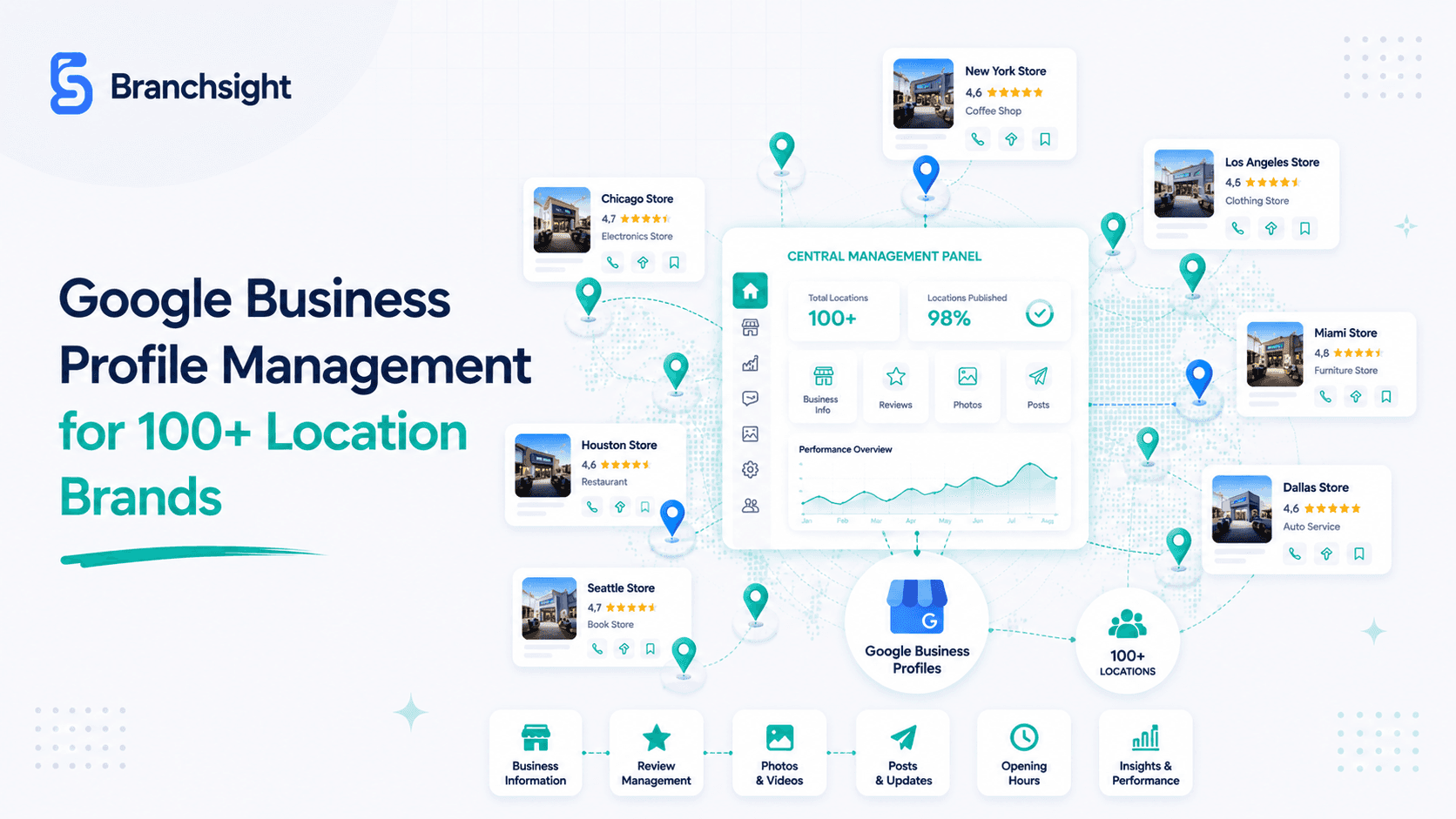
Google Business Profile Management for 100+ Location Brands
Sosyal Medya
June 10, 2026
Update:
Jun 10, 2026
In today's rapidly digitalizing world, the customer journey no longer begins on the street of your physical stores, but directly on the search engine screens of smartphones. A vast majority of consumers make decisions in seconds by searching for terms like "coffeeshops near me", "nearest insurance agency", or "authorized service centers around me" before leaving home. Right at this point, Google Business Profile (GBP) becomes the digital doorstep of businesses.
Managing this profile for an independent business with a single location can be a relatively simple daily routine. However, for huge dealer networks, franchise systems, and multi-location brands with more than 100, 500, or 1000 branches, ensuring each profile remains up-to-date, consistent, and open to engagement requires a serious operational vision. Trying to manually track hundreds of different addresses, phone numbers, business hours, and customer reviews can invite potential mistakes. But with the right strategies and technological infrastructures, it is entirely in your hands to turn this situation from a challenge into your brand's biggest local growth engine.
In this comprehensive guide, we will examine how brands with vast networks can manage their local digital presence from a single center with a scalable and positive approach, focusing directly on solutions and efficiency without overwhelming users with problems.
1. The Three Dynamic Pillars of Local SEO and Multi-Location Dynamics
Google's local search algorithm looks at three main signals to present users with the most accurate businesses: Relevance, Distance, and Prominence. Multi-location brands are usually highly advantaged in "Prominence" thanks to their national brand awareness. However, when it comes to "Relevance" and "Distance", each branch needs to strengthen its digital muscles in its own local area.
When a user performs a search, your brand's branch in that area must send the correct signals to the Google algorithm in order to appear in search results (especially in the first three results with maps, which we call the "Local Pack"). If you have 100 different locations, you must convince the algorithm separately for 100 different points. This requires establishing a profile management strategy that is standardized but with local touches for each branch. A properly structured central system automatically elevates these three algorithm signals to the highest level for all your branches.
2. Perfect Consistency in NAP Data: Laying a Solid Foundation
In the digital marketing world, the consistency of NAP (Name, Address, Phone) data is arguably the most important rule of local visibility. A brand's digital credibility depends on how accurate and up-to-date its data is.
In multi-branch structures, relocation of branch addresses, changes in phone numbers, or variations in business hours during holidays/official vacations are very common occurrences. If a branch in Istanbul appears with a closing time of 22:00 on Google, but in reality the branch closes at 20:00, the frustration experienced by a potential customer going to that branch directly turns into a 1-star review and damage to brand trust.
How is it Scaled?
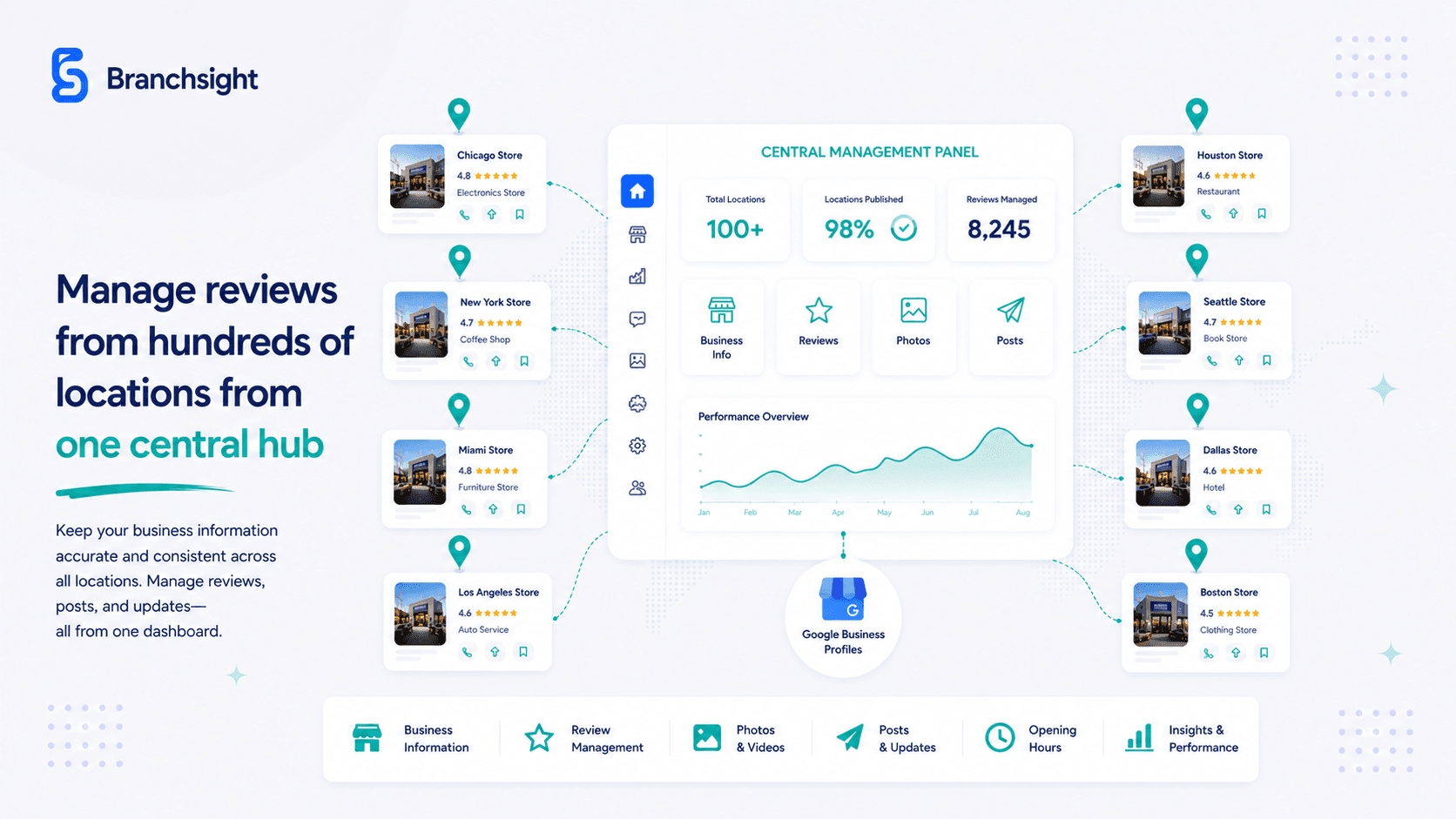
Central Information Management (Single Source of Truth): Manage data of hundreds of branches from a single central platform working integrated directly with Google APIs, instead of using Excel spreadsheets. This way, a single "official holiday hours" update made from the center is reflected in the profiles of 100 branches simultaneously in seconds.
Establishing Authority Hierarchy: Protect brand integrity by keeping core brand information (name, category, main address) under the control of the headquarters to ensure data security, while offering branch managers the flexibility to update only specific fields (e.g., uploading local photos) on a limited basis.
3. Scaling Content Management: Creating a Living Brand in Every Branch
Google Business Profile is not just a static address book, but also a live micro-social media platform. Google Posts, Products, and Services tabs allow brands to communicate with potential customers directly on the search results page before they even visit the website. The Google algorithm always moves "active" businesses that regularly update their profiles and post new entries to higher rankings.
However, for a brand with 100 branches, producing and sharing specific content for every branch each week might sound impossible. This is where automation comes into play.
How is it Scaled?
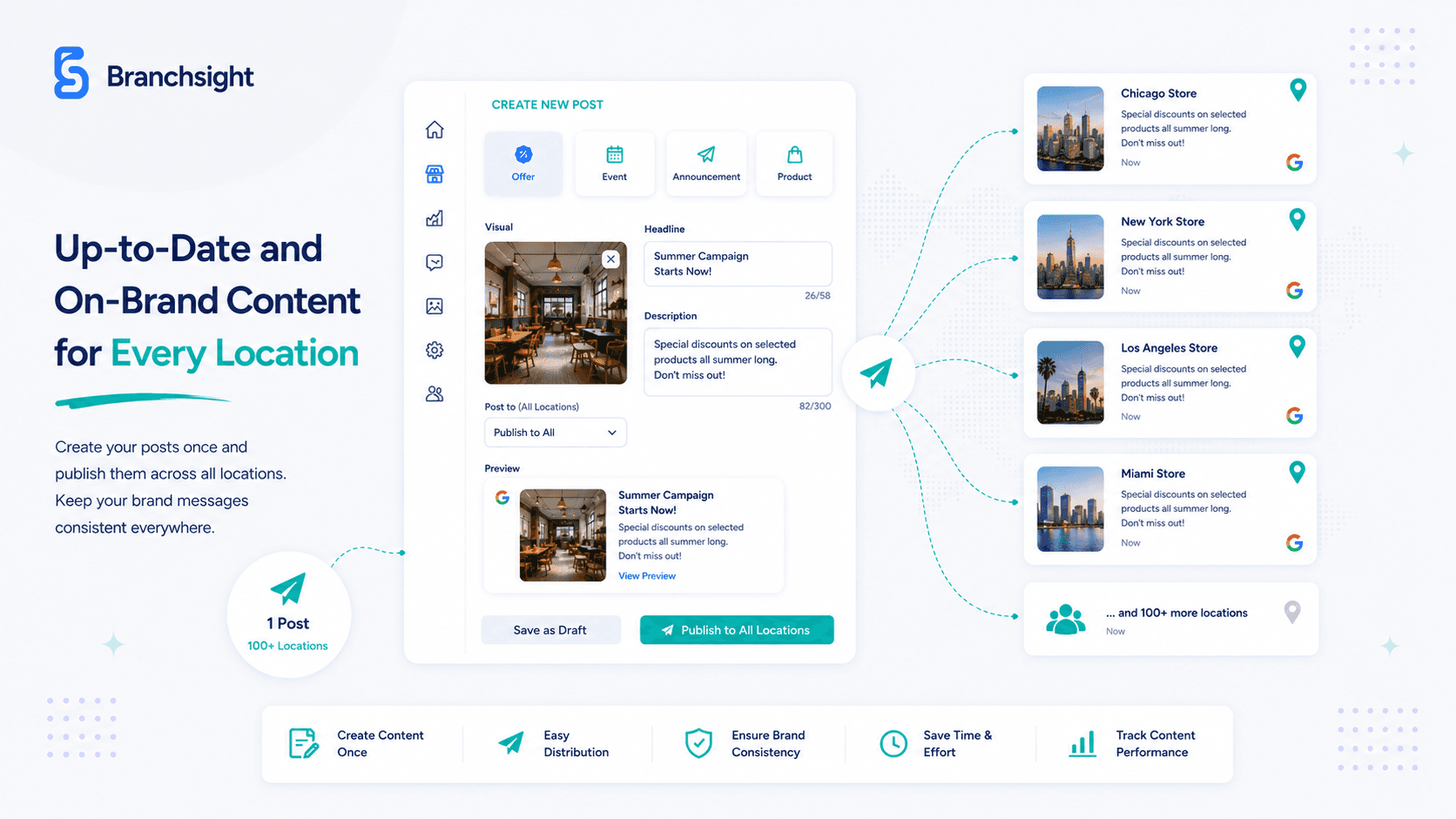
Dynamic Templates: The central marketing team prepares, for example, a national "Spring Campaign" visual. A scalable system takes this single visual and dynamically adds that branch's name or local information on top of it, sharing it across 100 branches simultaneously, looking as if it was custom-made for that branch (e.g., "Spring Special Deals for Our Kadıköy Branch!").
Planning for the Future: Just like your social media calendar, plan your Google profile posts weeks or months in advance on a regional basis. This way, branches remain continuously active and up-to-date with content provided from the center without taking on operational burdens.
4. Reputation Management and Harnessing the Power of Social Proof
Nearly 90% of modern consumers definitely read Google reviews before visiting a business or receiving a service. For a multi-location brand, reviews are not just customer feedback; they are unique data sources that take the pulse of the market in that region.
Although managing reviews is often perceived by brands as a time-consuming crisis management task, it is actually a wonderful opportunity to turn your existing customers into brand ambassadors. Responding quickly and constructively, especially to negative reviews, not only wins back that customer but also sends the message to thousands of other visitors of that profile: "We listen to our customers and care."
How is it Scaled?
Single-Screen Replying: Instead of switching between accounts to check reviews of hundreds of profiles, gather all reviews of the entire network on a single central dashboard.
Smart Reply Templates and Artificial Intelligence: Create dynamic reply templates matching the brand's tone of voice, tailored for FAQs or standard thank-yous. Instantly conduct sentiment analysis of the review using AI-powered assistants, and generate much faster, empathetic, and professional responses while staying loyal to your brand language. This approach ensures users do not feel helpless; instead, it reassures them of the brand's commitment.
5. Visual Appeal: Projecting Your Storefront to Digital
The human brain processes visuals much faster than text. Businesses on Google Business Profiles with high-quality, bright, and realistic photos get significantly more clicks and direction requests in search results compared to those without photos. Photos showing the branch's actual interior, its team, or its products rather than stock photos are the fastest way to build trust.
How is it Scaled? Establish a system that encourages your branch managers to upload high-quality visuals at regular intervals. With central audit mechanisms, block the publication of visuals that do not conform to the corporate standards of the brand (such as signage appearance, in-store window layout), ensuring a visual consistency of language across your network spanning Turkey or the world.
6. Data Analytics: Turning Insights into Action
The only way to understand if a strategy is successful is to measure it. The biggest advantage of multi-location brands is that they have a huge pool of local data. Which branch gets more views in search results? In which region do users plot more routes or click the call button via the profile?
How is it Scaled? Tag and group your branches by region, city, or performance metrics using advanced analytical tools. For example, compare the click-through rates of "Aegean Region Branches" from last month with the "Marmara Region". Identify underperforming branches and quickly take action by making tailored local SEO improvements for them (such as adding more photos or publishing a local post).
In Conclusion: Take Control and Focus on Growth
Managing Google Business Profiles for a brand with 100 or 1000 branches used to be a nightmare that required manual labor from hundreds of people. But today, with Branchsight, it is possible to fully automate this process with the right strategic vision and technological platforms, keeping it under the control of headquarters while ensuring local branches remain dynamic.
By managing your digital assets from a single powerful center, you can prevent data inconsistencies, turn your customer reputation into social proof, and achieve unrivaled visibility in local searches. Remember, every well-managed local profile is an open branch working for your brand 24/7, allowing you to acquire new customers at any moment. Accelerate your digital transformation and start providing your potential customers with an excellent experience on your digital storefront long before welcoming them at the door.